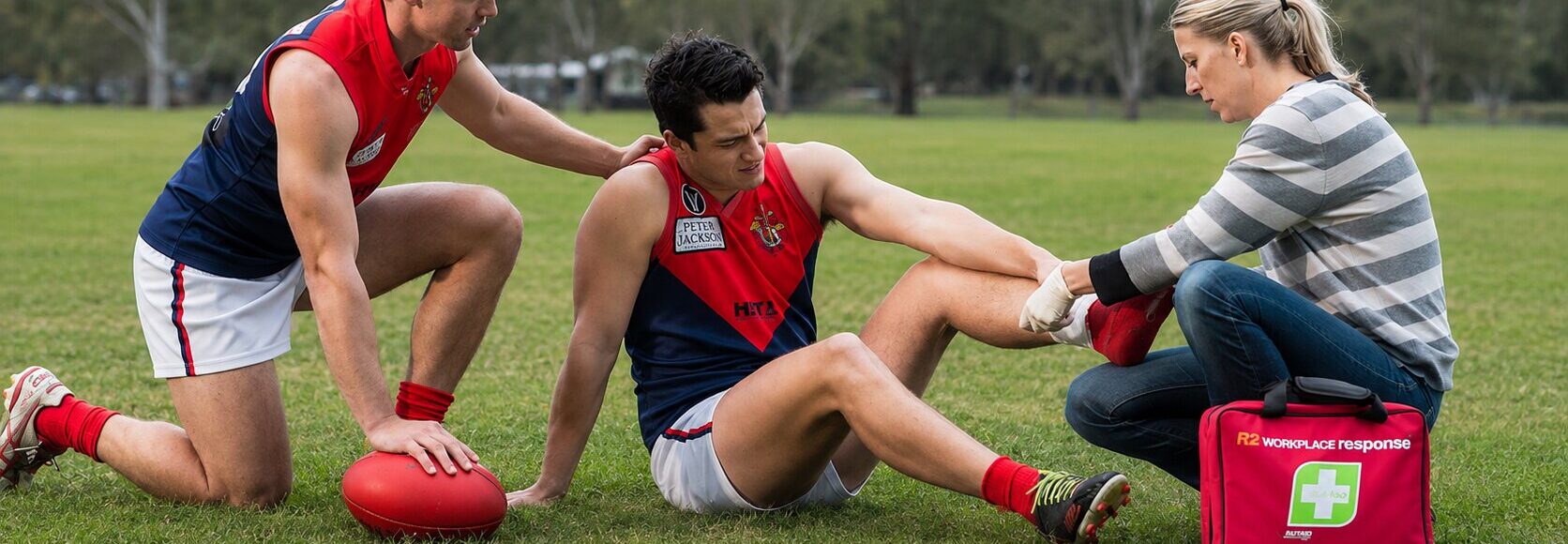
Level 1 Sports Trainer Course
The Level 1 Sports Trainer Course is designed for people supporting player welfare in community sport, including sports trainers, coaches, team managers, club volunteers and school sport staff. This practical course covers emergency planning, injury assessment, concussion, spinal injuries, soft tissue injury management, medical emergencies, stretcher procedures and sports taping. Participants must hold a current Provide First Aid certificate prior to attending. Delivered by Garry Bilson, Statewide Sports Medicine.
Participants are required to complete both theory and practical components.
Theory Assessment
A written theory workbook covering roles and responsibilities, emergency planning, communication, legal responsibilities, equipment and facilities, STOP, TOTAPS, concussion, neck and spinal injuries, RICER, HARM, infection control, head and facial injuries, and asthma management. The theory component must be completed either before the course or within three days of course completion.
Practical Assessment
Practical participation and demonstration of key skills, including emergency response, injury assessment and management, stretcher procedures, taping techniques and sport-specific injury management scenarios.
Participants must hold a current Provide First Aid certificate prior to attending this course.
Delivered by Garry Bilson, Director, Statewide Sports Medicine.
8 hours face-to-face training and assessment
4 hours face-to-face training and online e-Learning
Who Should Do This Course?
This course is suitable for people who have responsibility for player welfare, injury response or first aid support in a sporting environment, including:
- Sports trainers and first aid officers
- Coaches, assistant coaches and team managers
- Community sporting club volunteers and officials
- School sports coordinators and teachers involved in sport
- Anyone supporting match-day or training-session safety in community sport
What Is Included?
Sports trainer responsibilities:
- Role and responsibilities of the sports trainer
- Emergency planning, communication and relationships
- Record keeping, legal responsibilities and referral pathways
- First aid equipment, first aid facilities and safe sporting environments
Emergency response and injury assessment:
- DRSABCD emergency response priorities
- STOP on-field injury assessment
- TOTAPS injury assessment once the athlete is removed from play
- RICER soft tissue injury management and HARM factors following injury
Injury and medical emergency management:
- Concussion, unconscious casualties, neck and spinal injuries
- Soft tissue injuries, fractures, dislocations, upper and lower limb injuries
- Asthma, diabetes, epilepsy, heart conditions, stroke and severe allergic reactions
- Infection control and management of head, facial, ear, nose, eye, teeth and jaw injuries
Practical skills:
- Stretcher procedures and safe movement principles
- Practical injury assessment scenarios and role plays
- Sports taping techniques, including ankle, thumb, finger, wrist and knee taping
Injury prevention and risk management:
- Hydration and dehydration considerations
- Stretching, massage considerations and return-to-play principles
- Risk management discussion relevant to community sporting environments